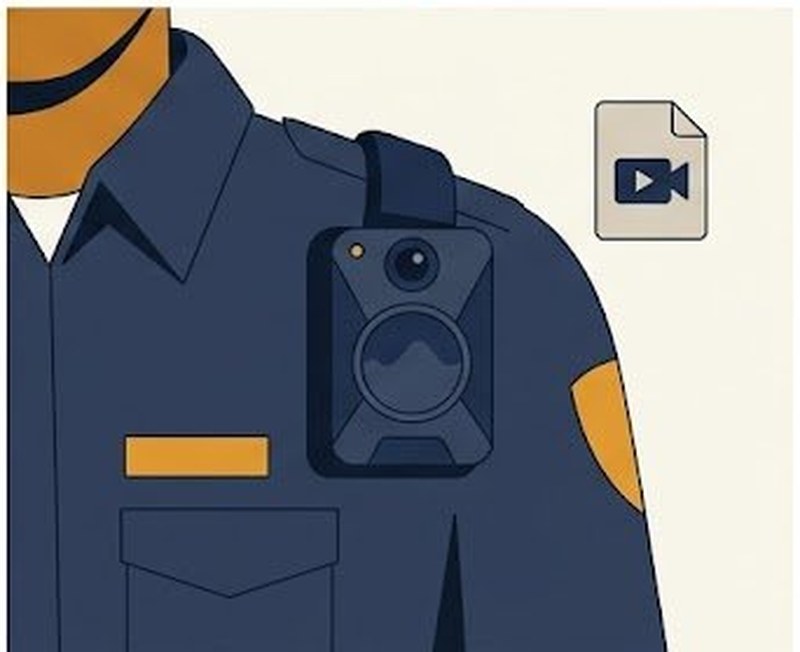
Who Holds the Footage?
Body camera footage is held by the law enforcement agency whose officer recorded it — there is no central state database. You must identify the correct department before filing:
- City police department — incidents within city/town limits
- County sheriff's office — incidents in unincorporated county areas
- State police / highway patrol — incidents on state highways involving state troopers
- Campus police — incidents on college or university property
- Transit police — incidents on public transit systems
Not sure which agency responded? Check any police report or incident number you received — the letterhead identifies the department. You can also call your county's non-emergency line and provide the date, time, and location.
What to Include in Your Request
Vague requests get delayed or denied. Include as many of these as you have:
- Date and approximate time of the incident
- Location — full address or intersection
- Incident or case number — from a police report if you have one
- Officer name or badge number — if known
- Your role — subject, witness, victim, involved party
- Brief incident description — one or two sentences
You do not need all of these. More detail = faster processing and less room for the agency to call the request too vague. Use our Request Letter Generator to produce a properly formatted request in under 2 minutes.
Retention Periods: How Long Does Footage Exist?
| Footage Category | Typical Retention | Notes |
|---|---|---|
| Routine patrol — no incident | 60–90 days | Auto-deleted in most agencies |
| Traffic stop, no arrest | 90–180 days | Varies widely by agency policy |
| Use of force incident | 2–5 years | Usually preserved once flagged |
| Officer-involved shooting | 5+ years or indefinite | Held as evidence through trial |
| Active complaint or lawsuit | Until resolution + appeal period | Litigation hold applies |
| After a formal request is filed | Preserved pending fulfillment | Filing triggers a hold in most agencies |
State-by-State Body Camera Disclosure Rules
Body camera footage is a public record in most states, but specific disclosure rules vary. Some states have dedicated body camera statutes on top of general public records law.
Florida
Body camera footage is subject to Florida's Public Records Law (Chapter 119). However, Florida Statute §119.071(2)(l) creates specific exemptions: footage recorded inside a private residence, health care facility, mental health facility, or any location where a person has a reasonable expectation of privacy is confidential and exempt from disclosure. Footage at emergency scenes may also be withheld. Importantly, the person who was recorded generally retains the right to their own footage regardless of these exemptions. Expect a 3-business-day acknowledgment and production as soon as reasonably possible.
Texas
Body camera footage is subject to the Texas Public Information Act (Chapter 552, Government Code). Texas agencies must release footage unless a specific exemption applies, and they must request an Attorney General ruling before withholding contested records — they cannot simply refuse. The AG typically rules within 45 business days. Requesters can appeal AG decisions to district court. Texas has one of the most pro-disclosure frameworks in the country for body camera footage.
California
Most body camera footage is subject to the California Public Records Act. Footage depicting officer-involved shootings and serious uses of force must be disclosed within 45 days under Penal Code §832.7 — California mandates proactive disclosure for these incidents even without a request. Footage of ongoing investigations may be temporarily withheld. Agencies can redact footage to protect witness identities or ongoing investigations but must provide an explanation log.
Georgia
Under the Georgia Open Records Act, body camera footage is presumed public. Agencies must respond within 3 business days. Footage of private residences may be withheld. Georgia has a robust disclosure framework, and excessive fees for redaction have been successfully challenged in court.
North Carolina
North Carolina stands apart: body camera footage is not automatically a public record under the Public Records Law. Instead, any person seeking footage must petition a Superior Court judge for an order of release. This makes NC one of the most restrictive states for body camera access. There is no administrative appeal option — if the agency denies access, your only recourse is the court petition process. If you have a compelling need for footage in NC, consider consulting an attorney who handles public records matters.
Pennsylvania
Body camera footage is subject to Pennsylvania's Right-to-Know Law. Pennsylvania's Office of Open Records (OOR) is a strong appeals body with real enforcement authority — OOR decisions are issued within 30 days. Agencies bear the burden of proving an exemption applies. Pennsylvania is considered one of the more effective states for public records enforcement.
States Without Specific Body Camera Laws
In states without dedicated body camera disclosure statutes, footage is treated like any other law enforcement record under the general public records law. The most common exemption used is the "ongoing investigation" exemption. Once a case is closed, this exemption no longer applies — re-submit your request after case closure if initially denied on these grounds.
How to Submit Your Request
- Online portal — Most large agencies use JustFOIA, GovQA, or their own portal. Search "[Agency Name] public records request online."
- Email to Records Division — Find the Records or Public Information contact on the department's official site.
- In person — Visit the department's records division during business hours. Bring ID and a written version of your request.
- Certified mail — Best for large agencies or when you need a documented paper trail. Address to the "Public Records Custodian."
If Footage Is Withheld
The agency must cite the specific statutory exemption for each record withheld — "we can't release this" is not a valid response. Your escalation options:
- Request an exemption log — Ask for each withheld record and the specific statute cited.
- File an administrative appeal — See our State-by-State Appeal Guide.
- Contact your state's transparency office — Many states have an ombudsman or open records officer who can mediate.
- File a court petition — Last resort. In states like Florida, you may be entitled to attorney's fees if the agency improperly withheld records.